

Key Takeaways
A used steering rack can be a sensible option when its fit, condition, history, and return terms are clear. Take time to verify the details before paying or arranging installation.
- Match the rack to the exact Chery model, year, and steering setup.
- Check photos and ask about wear, damage, testing, and storage.
- Compare the full cost, including delivery and installation.
- Have a qualified technician inspect the part and check alignment after fitting.
- Confirm warranty and return conditions in writing before purchase.
Confirm fitment for your Chery
A rack that looks right in a listing can still be wrong for your vehicle. Start with the exact model and year, then verify the steering configuration and identifying numbers before agreeing to buy. With second hand Chery steering racks, a careful fitment check can prevent the expense and delay of ordering a part that cannot be installed. For a useful point of comparison, you can also review a listing for used Chery Tiggo power steering, while confirming that the component and vehicle details match your own.
Match the rack to the exact model and year
Record the model name, model year, and any relevant production details from the vehicle identification plate or service records. Model names can cover more than one generation, and parts may differ even when two vehicles look similar. Ask the seller to confirm the rack was identified for the same version, rather than relying on a broad “fits Chery” description.
Check engine, trim, and steering configuration
Engine and trim details can help distinguish versions that share a model name. Confirm whether your vehicle uses hydraulic or electric power assistance and whether the rack is intended for the same arrangement. If you are unsure, check the owner’s manual or ask a technician to identify the existing setup before placing an order.
Compare the part number with your original rack
If the original rack is accessible, compare its part number with the number on the replacement or its label. A close visual match is useful, but matching identification details are stronger evidence than appearance alone. Ask for a clear image of the number and have a parts professional verify any superseded or alternate number before you commit.
Verify any differences between market versions
A vehicle sold under the same model name may have different specifications across markets. Check steering position and any market-specific details with the seller, then confirm against your vehicle documentation or a qualified parts source. If an answer is vague, pause the purchase rather than assuming that a rack from another market will fit.
Assess the rack’s condition
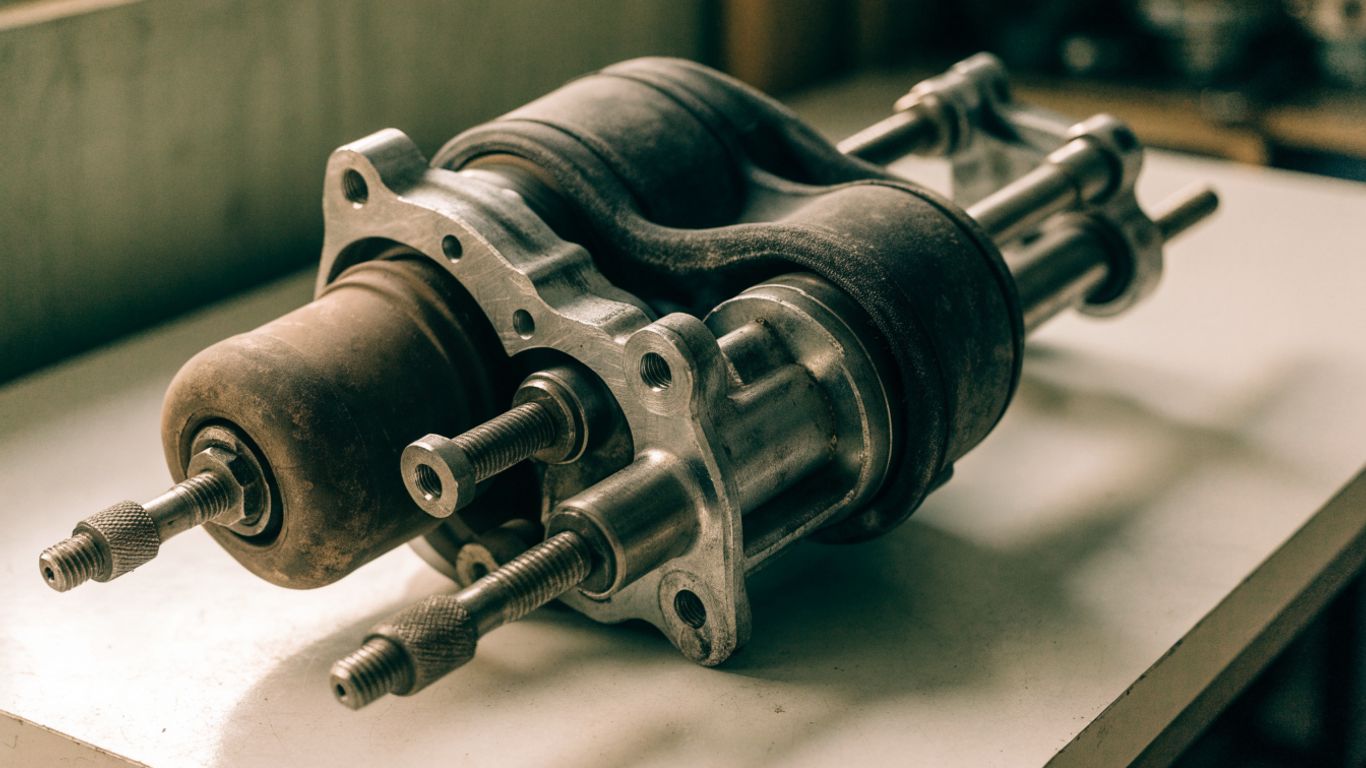
A used rack has a history, and its appearance can reveal some—but not all—of it. Ask for photographs of the complete assembly and close-ups of areas where damage or corrosion may be visible. If you can inspect it in person, do so before payment; if not, ask the seller to describe its condition in writing. The image below shows the sort of assembly and inspection details worth requesting, not a guarantee of any particular part’s condition.
Look for leaks, corrosion, and impact damage
Look for wet patches, residue, damaged boots, and corrosion around the housing and exposed fittings. Dents, bent sections, or signs of impact deserve particular scrutiny because a photograph may not show whether the internal parts have been affected. Ask the seller to explain any visible marks and to provide additional angles if a critical area is obscured.
Check the steering input shaft and mounting points
The input shaft and mounting points need to be free of obvious damage that could prevent proper installation or operation. Ask for close-up images of the shaft end, mounting ears, and threaded areas. Avoid assuming that a missing bolt or surface mark is harmless; have a technician assess anything that looks bent, cracked, or heavily worn.
Ask how the rack was inspected or tested
A seller may describe a visual inspection, a functional test, or no testing at all. Ask what was actually done and whether the rack was checked for leakage or smooth movement. A clear explanation helps you judge what remains unknown; it does not replace an inspection by a qualified technician.
Treat missing details as a reason to investigate further
When condition information is thin, request what is missing before sending money. A few focused questions can clarify whether the seller knows the part’s history and is willing to stand behind the description. Keep the conversation practical, and save the answers so there is a written record if the part arrives differently than described.
A short set of questions can make that exchange more useful:
- Are there visible leaks, cracks, or impact marks?
- Was the rack tested, and what did the test involve?
- Can you provide close-up photos of the part number and mounting points?
- What condition or defects are excluded from the listing?
Use the replies to decide whether the remaining uncertainty is acceptable. If the seller cannot answer basic questions or declines to provide clear photographs, consider looking for a better-documented option.
Evaluate the seller and part history
A trustworthy transaction depends on more than the part itself. Ask where it came from, how it has been handled, and what the seller will do if the item is not as described. Look for consistent business details and a clear written listing. Keep your research focused on vehicle parts: search results can also surface unrelated topics such as solo Seine cruises, backlink providers, garage door styles, automatic watches, and Chinese car exports, none of which can establish a rack’s fitment or condition.
Ask about the vehicle the rack came from
Ask for the donor vehicle’s model, year, and, if available, mileage and reason for dismantling. The seller may not know every detail, but a specific account is more useful than a generic assurance that the part is good. Compare the donor information with your own vehicle and ask a professional to resolve any uncertainty about compatibility.
Request clear photos and identifying numbers
Request recent images of the actual rack, not just a representative picture. Useful photos show the full assembly, its labels or stamped numbers, the input shaft, mounting points, and any areas of concern. If you are comparing listings, keep the images and part numbers together so that you do not mistake one seller’s details for another’s.
Check the seller’s reputation and business details
Look for a working contact method, a clear business identity, and consistent information about payment, shipping, and returns. Reviews can help you form a view, but read for specific transaction details rather than relying on a star rating alone. Be cautious if the seller pressures you to pay quickly or will not put important promises in writing.
Find out whether the rack has been stored properly
Ask how the part was stored and whether openings were protected from dirt or moisture. Poor storage can leave a part exposed to contamination or corrosion, even if it looked serviceable when removed. A seller’s description should be considered alongside a physical inspection, not as a substitute for one.
Compare the total cost
The listed price is only one part of the decision. Delivery, taxes, possible core charges, inspection, and installation can change which option is more economical. Compare like with like: the same broad fitment, similar documented condition, and comparable return protection. Before deciding, write down the likely costs so a low headline price does not obscure the full outlay.
Compare prices for equivalent racks
Compare listings only after checking that they refer to compatible parts and provide similar information about condition. A cheaper rack with no photos, testing details, or return option may not offer the same value as a better-documented part. Use more than one quote where possible, and ask sellers to clarify what is included in the price.
Include shipping, taxes, and core charges
Ask for the delivered total and confirm whether taxes or handling charges will be added. If a core charge applies, find out how and when it is refunded and what condition the returned core must be in. Get these terms in writing; otherwise, an apparent price comparison may leave out costs that matter.
Factor in inspection and installation costs
A technician may charge to inspect the replacement before fitting, and installation itself can be a substantial part of the total. Ask whether additional steering work or alignment may be needed, but rely on a professional assessment rather than assuming the rack is the only concern. These costs belong in the comparison from the outset, not as an afterthought.
Weigh the savings against the risks
A used part may cost less upfront, but the value depends on its condition, fitment certainty, and the protection offered if something is wrong. The table provides a simple way to compare offers without treating price as the only deciding factor.
| Comparison point | What to confirm | Why it matters |
|---|---|---|
| Fitment | Model, year, configuration, and part number | Reduces the chance of ordering an incompatible rack |
| Condition | Photos, inspection, and test details | Helps identify unknowns before purchase |
| Total cost | Delivery, taxes, core charges, and fitting | Shows the likely full expense |
| Protection | Warranty, return window, and exclusions | Clarifies your options if the part is unsuitable or defective |
A listing that scores well on price but poorly on fitment or protection may be the less sensible purchase. Compare the complete picture and choose only when the remaining risks are clear to you.
Plan installation and testing
Steering is a safety-critical system, so plan the fitting rather than treating it as a simple parts swap. Have the rack checked by a qualified technician and ask what else should be inspected while the vehicle is being serviced. After installation, confirm that the steering operates evenly and that the vehicle meets the required alignment specifications. A general repair video can provide context, but it cannot replace the vehicle-specific service information or professional judgment.
Have a qualified technician inspect the rack
Arrange an inspection before installation where practical, especially if the part has limited testing information or has travelled a long distance. A technician can assess visible damage and whether the rack appears suitable to proceed with fitting. Share the seller’s description and any photos so the inspection can address the specific uncertainties you have identified.
Check whether related steering components need attention
Ask the technician to check related steering parts and connections for wear or damage. A replacement rack cannot correct problems elsewhere in the system, and worn adjacent components may affect how the vehicle feels afterward. The inspection should determine what needs attention rather than assume every related part must be replaced.
Follow the vehicle’s alignment requirements
Follow the service information for the exact vehicle, including any alignment checks required after fitting. Do not rely on steering-wheel position alone as proof that alignment is correct. A qualified shop can measure and adjust the relevant settings, then explain any issue that remains.
Test for leaks, noise, and uneven steering after installation
After fitting, check for fluid leaks where applicable, unusual noise, binding, or an uneven steering response. If anything feels wrong, stop and return to the technician rather than continuing to drive in the hope it will settle. Keep a record of the inspection and any post-installation checks.
Understand warranty and return terms
Used-part policies vary, so read the terms before paying and make sure they cover the situation you are concerned about. Ask what counts as a defect, whether installation must be performed by a professional, and how quickly you must report a problem. A return right may have conditions that affect the practical value of a purchase. Written terms are much easier to rely on than an informal promise.
Check the coverage period and exclusions
Confirm how long coverage lasts and when that period begins: at purchase, delivery, or installation. Ask which failures are covered and whether labor, shipping, or consequential costs are excluded. Do not assume that “warranty included” means every expense will be reimbursed.
Confirm the return window and restocking fees
Find out how many days you have to report a fitment issue or request a return, and whether the item must remain uninstalled. Ask about restocking fees and who pays return shipping. If fitment can only be confirmed during installation, clarify that point before ordering.
Ask how a defective part must be documented
Ask what evidence the seller needs if a problem occurs, such as photographs, a technician’s report, or proof of installation. Confirm how to notify the seller and whether the rack must be returned before a decision is made. Clear instructions can prevent delays when a claim is time-sensitive.
Keep receipts and fitment records
Save the invoice, listing, seller messages, part-number photos, and any technician’s inspection notes. These records make it easier to show what was advertised and how the part was identified. Keep them together through installation and the warranty period.
Conclusion
Buying a used Chery steering rack takes more than finding a listing at an attractive price. Verify the exact fit, ask direct questions about condition and history, compare the full cost, and plan for professional inspection and installation. When the seller’s answers and return terms are clear, you can make a more informed decision; when key details remain uncertain, it is reasonable to keep looking.
Frequently Asked Questions
How can I tell whether a used steering rack fits my Chery?
Confirm the exact model and year, steering configuration, and part number against your original rack or vehicle records. If any detail differs or is unclear, ask a qualified parts professional to verify compatibility before purchase.
What should I check in photos of a used steering rack?
Look for clear views of the whole assembly, the input shaft, mounting points, identifying numbers, and any visible leaks, corrosion, or impact damage. Ask for more images if an important area is hidden.
Is it safe to buy a steering rack that has not been tested?
An untested part carries more uncertainty. Ask what inspection has been done and have a qualified technician assess it before installation; a seller’s description alone cannot establish that it is safe or suitable.
What costs should I include when comparing used racks?
Include the part price, shipping, taxes, any core charge, inspection, and installation. Also ask about potential return shipping or restocking fees so you understand the full possible expense.
Should a technician inspect the rack before it is installed?
An inspection is a prudent step, particularly when the part’s history or test details are limited. A technician can assess visible condition and help determine whether it is suitable to fit.
Does a return policy guarantee a full refund?
Not necessarily. Policies may include deadlines, condition requirements, exclusions, or restocking and shipping fees. Read the written terms and ask the seller to explain anything unclear before ordering.
What records should I keep after buying a used rack?
Keep the receipt, listing, seller correspondence, part-number and condition photos, warranty terms, and inspection or installation records. These documents can help if a fitment or defect issue arises.