
Key Takeaways
Transmission and drivetrain describe related but different parts of the system that moves a vehicle. Understanding their jobs makes it easier to choose maintenance, recognize trouble, and compare repair options.
- The transmission adjusts engine speed and torque for changing driving conditions.
- The drivetrain carries that power from the transmission to the driven wheels.
- FWD, RWD, 4WD, and AWD layouts behave differently on pavement and loose surfaces.
- Fluid condition, heat, wear, and driving habits all affect service life.
- Early diagnosis can prevent a small fault from becoming a major repair.
What the transmission and drivetrain do
A vehicle moves because several mechanical systems cooperate rather than because one part does everything. The engine produces rotating power, the transmission adapts that power, and the drivetrain carries it to the wheels. In everyday conversation, people sometimes use the terms interchangeably, but a clear distinction helps when discussing performance or repairs. A useful drivetrain overview also separates the drivetrain from the larger powertrain, which includes the engine or motor.
How engine power becomes wheel movement
Combustion inside the engine creates force that turns the crankshaft. That rotation passes through a connection point, then into the transmission, where the relationship between engine speed and wheel speed can be changed. From there, shafts, gears, differentials, axles, and hubs deliver rotation to the tires. The tires turn against the road surface, converting mechanical rotation into forward or backward movement.
The engine is most useful within a certain operating range. It cannot efficiently provide the ideal combination of speed and pulling force for every situation, from starting at a stop to climbing a hill or cruising on a highway. The rest of the system makes those changing demands manageable without requiring the engine to operate at one extreme all the time.
The transmission’s role in changing speed and torque
The transmission uses gear ratios to alter how quickly the output shaft turns in relation to the engine. A lower gear multiplies torque at the wheels, which helps with starting, climbing, and carrying a load. A higher gear reduces engine speed during steady travel, improving quietness and often fuel economy.
This is why a transmission is more than a simple set of gears. It must connect and disconnect power, select an appropriate ratio, and manage the transition between ratios. In an automatic vehicle, hydraulic pressure, electronic controls, or both coordinate that work. In a manual, the driver makes more of the decisions through the clutch pedal and gear lever.
How the drivetrain transfers power to the wheels
The drivetrain begins at the transmission output and includes the parts that carry mechanical power toward the drive wheels. Depending on the layout, that route may be short, as in a front-wheel-drive car, or may run through a driveshaft and differential to a rear axle. The differential allows wheels on the same axle to rotate at different speeds while turning a corner.
A drivetrain reference guide is useful for seeing how the gearbox, drive shaft, axles, and wheels fit into that chain. Each component has to tolerate torque, heat, vibration, and changing loads. A worn bearing or joint may not stop the vehicle immediately, but it can make power delivery rough and place extra stress on nearby parts.
Why both systems matter for vehicle performance
Transmission behavior influences acceleration, engine noise, fuel use, and the feel of each shift. Drivetrain layout affects traction, steering feel, weight distribution, turning behavior, and how confidently the vehicle can put power onto the road. These systems cannot be judged separately when diagnosing a complaint such as a shudder, clunk, or loss of drive.
The distinction becomes especially useful during service. A delayed shift points toward one group of possibilities, while a clicking axle joint or noisy differential points toward another. Knowing which system is involved helps an owner describe symptoms accurately and helps a technician test the right components first.
Understanding the main transmission types
Transmission designs solve the same basic problem in different ways: matching engine output to the vehicle’s changing speed and load. Some give the driver direct control, while others select ratios automatically. The choice affects response, maintenance, efficiency, and how the vehicle feels in traffic. The broad comparison in this transmission types guide can help frame those differences without reducing them to a simple “best” choice.
Manual transmissions and driver-controlled gear changes
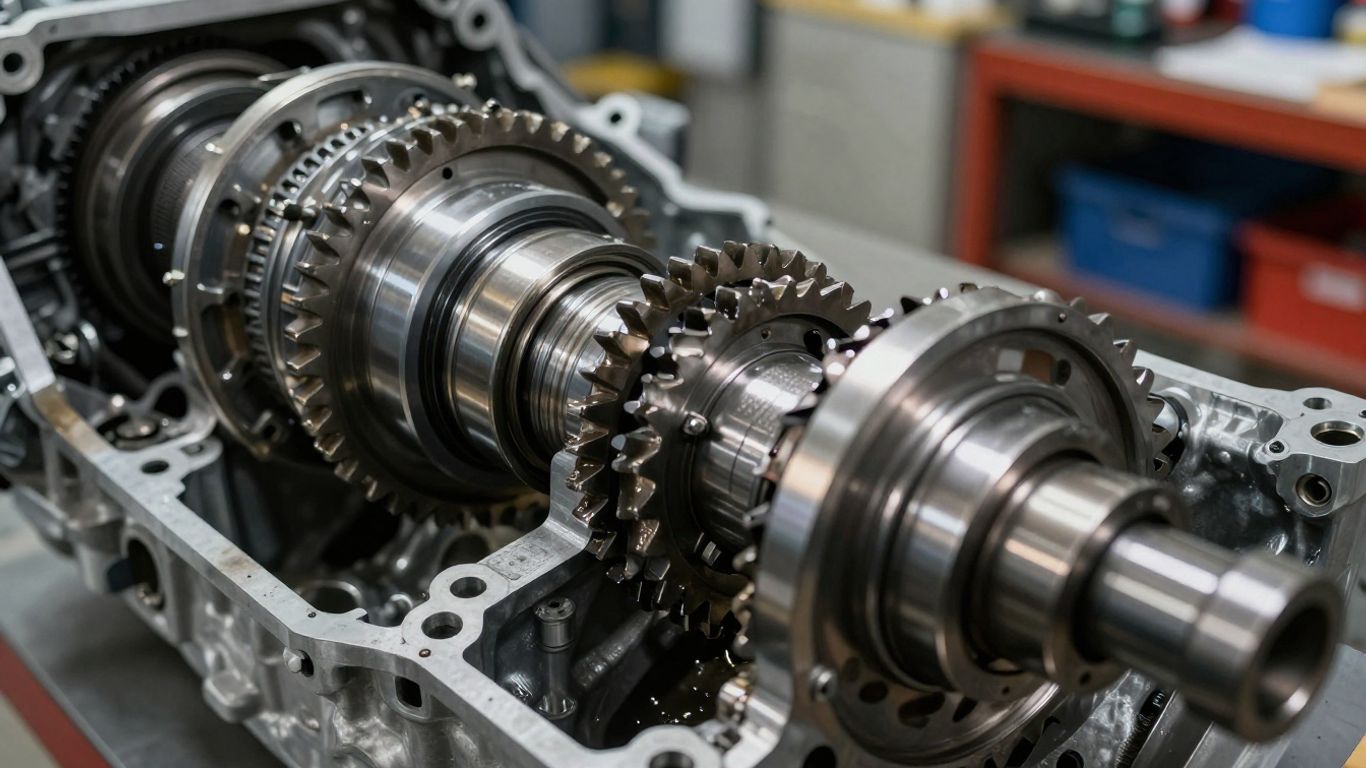
A manual transmission uses a clutch to temporarily separate the engine from the gearbox while the driver selects another gear. The driver decides when to shift and how smoothly to release the clutch. That direct control can be useful when managing a hill, towing within the vehicle’s limits, or choosing engine braking on a descent.
Manual gearboxes are mechanically straightforward in principle, but the clutch is a wear item. Frequent stop-and-go driving, resting a foot on the pedal, or holding the vehicle on a hill with clutch slip can shorten its life. A healthy manual should engage cleanly, remain in gear, and avoid grinding when the clutch is fully depressed.
Automatic transmissions and hydraulic shifting
A conventional automatic transmission uses a torque converter rather than a manually operated clutch pedal. Inside the transmission, planetary gear sets, clutches, bands, hydraulic circuits, and electronic controls work together to select ratios. The torque converter allows the engine to keep running while the vehicle is stopped and helps multiply torque during initial movement.
Modern automatics may have several forward ratios and sophisticated control strategies. They can respond to throttle position, road speed, load, and temperature. Smoothness depends on correct fluid level, clean hydraulic passages, sound sensors, and properly functioning internal friction elements.
Continuously variable transmissions and seamless ratios
A continuously variable transmission, or CVT, does not rely on a fixed sequence of conventional stepped gears in the same way as a traditional automatic. It changes the ratio across a range, commonly through paired variable-diameter pulleys and a belt or chain. The engine can stay near an efficient operating speed while the transmission adjusts the ratio as the vehicle accelerates.
The result may feel different from familiar gear changes. Engine speed can rise and hold while road speed continues to build, which some drivers describe as a smooth or elastic response. CVTs require the correct fluid and service procedure because their components and control systems are designed around specific friction and pressure characteristics.
Dual-clutch transmissions and rapid gear changes
A dual-clutch transmission uses two clutches to manage alternating groups of gears. One clutch can be connected to the current gear while the next ratio is prepared, allowing a rapid change when conditions are right. The design can provide a direct, quick-shifting feel without requiring the driver to operate a clutch pedal.
Low-speed behavior depends heavily on calibration and clutch control. Crawling in traffic, repeated hill starts, or heat buildup can place demanding conditions on the clutch packs. As with any transmission, the correct fluid, temperature management, and software or mechanical diagnosis matter more than a label alone.
Exploring drivetrain layouts
Drivetrain layout determines which wheels receive engine torque and where major components sit in the vehicle. That arrangement changes traction, handling, packaging, and service needs. No layout is perfect for every driver or road. The useful drivetrain and transmission comparison explains the distinction while also outlining how FWD, RWD, AWD, and 4WD influence vehicle behavior.
Front-wheel drive for efficiency and everyday handling
In a front-wheel-drive vehicle, the front wheels steer and propel the vehicle. The engine and transmission are often packaged together at the front, which can save space and reduce the number of long power-transfer components. The weight over the driven wheels can also help on wet or lightly snowy roads.
Because the front tires handle both steering and acceleration, strong throttle input can influence steering feel. Tire condition and alignment matter greatly. A worn outer CV joint, damaged boot, or uneven front tire can affect both movement and cornering.
Rear-wheel drive for balance and performance
Rear-wheel drive sends engine torque to the rear wheels, leaving the front tires primarily responsible for steering. Many vehicles use a driveshaft running from the transmission to a rear differential, followed by axle shafts. This arrangement can support balanced handling and strong acceleration, especially when the vehicle is designed around it.
On slippery roads, the rear tires may lose traction more readily if weight is concentrated elsewhere. Throttle control, tires, stability systems, and road conditions all influence the outcome. A rear-wheel-drive layout is not automatically less safe; it simply responds differently to load and available grip.
Four-wheel drive for demanding terrain
Four-wheel drive commonly connects both axles through a transfer case and is designed for conditions where extra traction and controlled torque delivery are valuable. Some systems offer low-range gearing for slow travel over steep, uneven, or loose terrain. The added hardware brings more weight and more components to maintain.
Four-wheel drive should not be treated as permission to exceed the vehicle’s limits. Tires, clearance, suspension, recovery equipment, and driver judgment remain decisive. On high-traction surfaces, using a locked or part-time mode incorrectly can create driveline wind-up and stress.
All-wheel drive for variable traction conditions
All-wheel-drive systems can distribute torque between axles automatically or according to selectable driving modes. Sensors and control units may react to wheel slip, throttle input, steering angle, and other conditions. The aim is to maintain useful traction as grip changes, rather than requiring the driver to select every transition.
AWD does not shorten braking distance by itself, and it cannot overcome worn tires or excessive speed. It may improve acceleration traction in rain, gravel, or snow, but the rest of the vehicle still determines how it turns and stops. Differences in tire size or wear can also be significant on systems that monitor wheel speed closely.
Key components in a drivetrain system
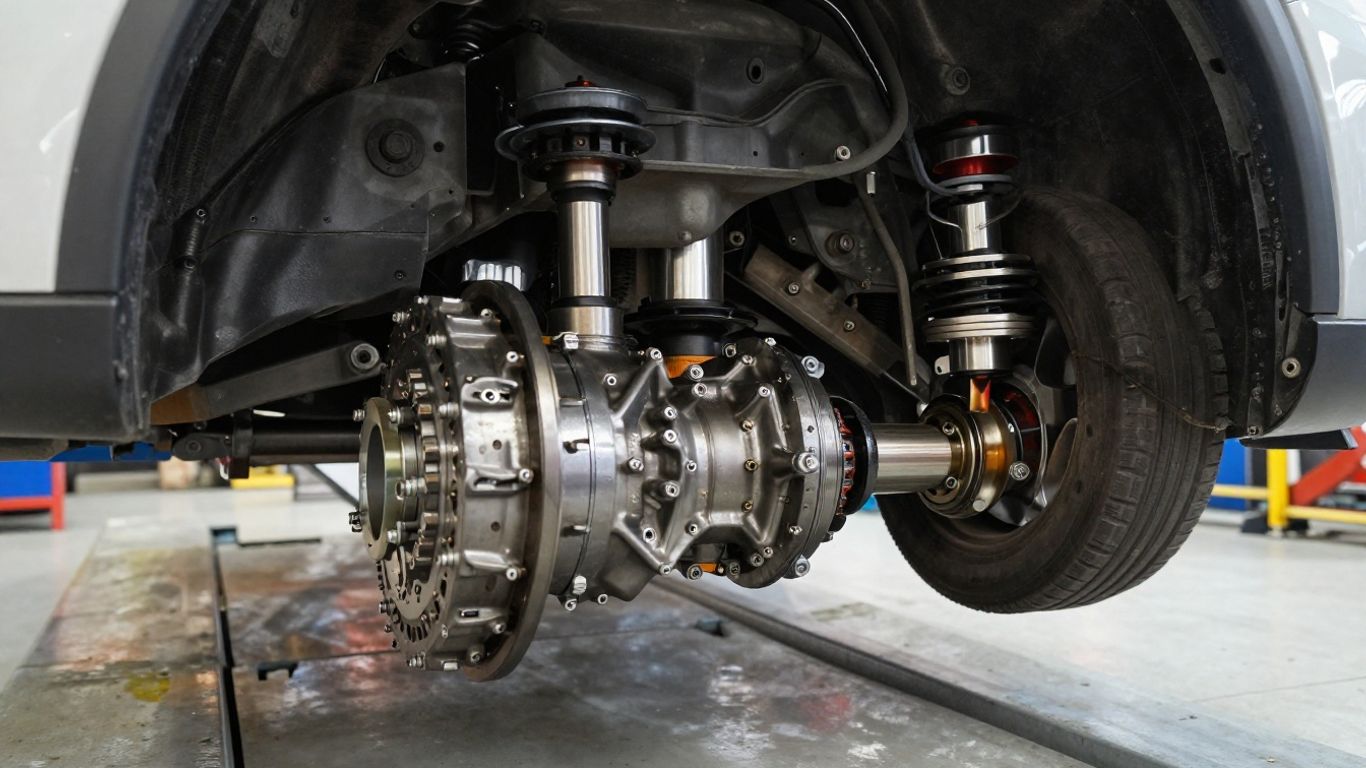
A drivetrain is a chain of components, and the chain is only as dependable as its most stressed connection. Some parts control engagement, some change speed, and others carry torque over distance or around corners. Their names can sound abstract until a symptom appears. The drivetrain mechanics explanation offers another way to connect gear ratios and power transfer with the parts underneath the vehicle.
Clutches, torque converters, and flywheels
A clutch creates a controllable connection between the engine and a manual transmission. It includes friction material and pressure components that must engage firmly without grabbing or slipping. The flywheel provides a smooth mounting surface and helps moderate the pulses produced by the engine.
An automatic transmission uses a torque converter to transmit power through fluid. It can multiply torque at low speed and use a lockup clutch during cruising to reduce slip. Problems in either arrangement may appear as slipping, shuddering, difficult engagement, or unusual heat.
Gear sets, shafts, and differentials
Gear sets determine the available ratios, while shafts carry rotation through the transmission and final drive. Bearings support those rotating parts and keep them aligned. A differential then divides torque between the wheels while allowing different wheel speeds during a turn.
Different differentials suit different needs. An open differential is simple and smooth, while limited-slip or locking designs can improve traction in particular situations. Those systems also have their own fluid requirements and wear patterns, so a noise from the axle housing deserves more than a general transmission check.
Transfer cases and driveshafts
A transfer case is used in many four-wheel-drive and all-wheel-drive arrangements to route power to more than one axle. It may contain gears, chains, clutches, and selectable ranges. Driveshafts then carry rotation along the vehicle, often through universal joints, constant-velocity joints, and support bearings.
Vibration that changes with road speed can come from an imbalance, worn joint, damaged shaft, or failed support bearing. Inspecting the complete path is more reliable than replacing the first part that seems close to the symptom. The same principle applies to electrical accessories: secure, suitable wire connectors matter where auxiliary wiring is added, but they do not repair a mechanical drivetrain fault.
Axles, CV joints, and wheel hubs
Axles transmit torque from a differential or transaxle to the wheels. CV joints allow that transfer while accommodating steering angle and suspension movement, particularly on front-wheel-drive vehicles. Protective boots keep grease in and dirt out, so a torn boot can become a larger joint problem if ignored.
Wheel hubs contain bearings and provide the mounting point for the wheel assembly. Bearing wear may produce a hum that changes during cornering, while a damaged joint often clicks under steering load. These sounds are not interchangeable, and a road test combined with a physical inspection is usually needed to separate them.
Transmission and drivetrain maintenance
Maintenance is mostly about controlling heat, friction, contamination, and wear before they become failures. The correct schedule depends on the vehicle, transmission design, fluid specification, use, and climate. A service procedure that is appropriate for one model may be wrong for another. Keeping accurate records also gives a technician a clearer history when a new symptom appears.
Checking and changing transmission fluid
Transmission fluid lubricates, cools, cleans, and transfers hydraulic pressure in systems that use hydraulic control. Its level and condition should be checked only according to the manufacturer’s procedure, since some transmissions require a specific temperature range and inspection method. The fluid may darken with age, but color alone does not provide a complete diagnosis.
Use only the specified fluid and filter parts. Mixing fluids or adding an unapproved additive can change friction behavior and seal compatibility. A fluid change may be sensible maintenance, but it cannot reverse damaged gears, burned clutches, or a failing pump.
Inspecting drivetrain components for wear
A careful inspection includes more than looking for a puddle beneath the transmission. Boots, seals, mounts, driveshaft joints, differential housings, axle shafts, and wheel bearings all deserve attention. Small cracks or looseness can develop into play, vibration, or loss of lubrication.
A practical inspection sequence can keep a routine check organized:
- Look for fluid traces around seals, housings, and cooler lines.
- Check CV boots, universal joints, mounts, and shields for damage or looseness.
- Listen for changes during acceleration, coasting, turning, and shifting.
- Compare tire size, pressure, and wear across the driven axle or axles.
This sequence does not replace a professional diagnosis, but it helps connect a symptom with the conditions under which it occurs. Notes about temperature, speed, load, and whether the vehicle is turning can be surprisingly useful.
Following service intervals and driving recommendations
Service intervals are based on design assumptions about heat, load, mileage, and time. Severe use can include frequent towing, dusty roads, stop-and-go traffic, extreme temperatures, or repeated short trips. A vehicle used in those conditions may need more frequent inspection than one driven gently on open roads.
The owner’s manual should guide fluid specifications, towing limits, shift-mode use, and inspection timing. If a vehicle has a maintenance reminder, treat it as a prompt rather than a substitute for the schedule. Preventive work is usually easier to plan than an unexpected loss of drive.
Preventing damage from towing, overheating, and hard use
Extra weight raises demand on the engine, transmission, cooling system, brakes, and drivetrain. Staying within the rated capacity is only the starting point; correct hitch setup, trailer balance, tire pressure, and sensible speed also matter. Heat is especially dangerous when fluid cannot shed it effectively.
Avoid holding a vehicle on a steep incline with throttle alone, spinning the tires repeatedly, or switching drivetrain modes outside the conditions described in the manual. After demanding use, pay attention to new smells, delayed engagement, or changes in shift quality. Those clues can appear before a warning light does.
Common problems and warning signs
A drivetrain problem rarely announces itself in one perfectly clear way. The same symptom can result from fluid level, electronic control, worn friction material, a mount, a joint, or a differential. Diagnosis should consider when the symptom happens and whether it changes with speed, engine load, steering angle, or temperature. Early attention is valuable because continued driving can turn a contained fault into damage across several components.
Slipping gears and delayed engagement
Slipping occurs when engine speed rises without a matching increase in vehicle speed. Delayed engagement may feel like a pause after selecting Drive or Reverse, followed by a sudden connection. Low fluid, internal wear, hydraulic problems, sensor faults, or clutch damage can all be involved.
Do not repeatedly race the engine to overcome the symptom. That creates more heat and can accelerate wear. Record whether the problem occurs only when cold, after warming up, on hills, or during a particular shift, then arrange a proper inspection.
Grinding, clunking, and whining noises
Grinding during a gear change may point to clutch release, synchronizer, gear, or bearing trouble in a manual transmission. A clunk when selecting Drive or changing direction can also involve mounts, universal joints, differential backlash, or axle play. Whining that follows vehicle speed often deserves inspection of bearings, gears, or fluid level.
Noise location can be deceptive because sound travels through the body and frame. A road test, lift inspection, and fluid examination can narrow the source. Avoid assuming that every noise near the transmission comes from the transmission itself.
Fluid leaks, burning smells, and overheating
A leak can lower fluid level and deprive internal parts of lubrication or hydraulic pressure. Fluid may appear red, amber, brown, or nearly black depending on its age and formulation, so identification by appearance alone is unreliable. Burning smells can indicate overheated fluid, a slipping clutch, or another component contacting excessive heat.
Stop and seek advice promptly if the temperature warning appears, smoke is visible, or the vehicle loses drive. Continuing to travel while a transmission is overheating may damage seals, friction elements, wiring, and control components. The location and timing of a leak are useful clues even when the source is difficult to see.
Vibrations, shuddering, and uneven power delivery
A shudder during acceleration can come from a torque converter clutch, engine misfire, axle joint, tire, mount, or driveshaft. Vibration that rises with road speed may point toward wheels, tires, bearings, or rotating shafts. Uneven power delivery can also be caused by control software or an engine problem rather than a transmission fault.
Describe the symptom precisely: speed, gear, throttle position, road surface, temperature, and whether the vehicle is turning. That information helps separate engine-related hesitation from a drivetrain vibration. If the vehicle feels unsafe or the vibration suddenly worsens, reduce speed and have it inspected rather than testing it aggressively.
Choosing repairs, upgrades, or replacement options
Repair decisions should follow diagnosis, vehicle condition, expected use, and total cost rather than fear of the largest possible failure. A transmission rebuild, a targeted component repair, a used replacement, and a new or remanufactured unit each carry different risks and warranties. The right choice for a high-mileage commuter may differ from the right choice for a carefully maintained work truck.
When a transmission rebuild makes sense
A rebuild can make sense when the case and major hard parts are serviceable but internal friction components, seals, bearings, or selected gears need replacement. It allows the technician to inspect the unit closely and address known wear areas. The quality of the result depends on diagnosis, parts selection, machining, assembly, calibration, and warranty support.
Ask what failed, which parts will be replaced, and what testing follows assembly. A vague promise to “freshen everything” is less useful than a written scope of work. Also determine whether the underlying cause, such as overheating or contamination, will be corrected.
Comparing repair costs with full replacement
A replacement unit may reduce downtime and provide a clearer warranty, but compatibility and installation quality remain critical. A repair may cost less when the fault is limited, yet repeated partial repairs can become expensive if the unit has broad internal damage. Labor, programming, fluid, cooler flushing, mounts, seals, and diagnostic time belong in the comparison.
The cheapest quoted part is not always the lowest total cost. Compare warranty length, exclusions, availability, expected service life, and who handles a follow-up problem. A reliable estimate should distinguish confirmed damage from possible additional findings discovered after disassembly.
Evaluating performance and off-road upgrades
Upgrades should solve a defined need, such as additional cooling, stronger protection, improved gearing, or better traction control. More aggressive parts can change noise, ride comfort, fuel use, tire wear, and stress on other components. The vehicle’s engine output, tire diameter, axle strength, suspension, brakes, and intended terrain must be considered together.
For off-road use, a stronger component does not remove the need for proper recovery technique or sensible throttle control. An upgrade that exceeds the capacity of neighboring parts may simply move the failure to another point in the system. Compatibility is more valuable than a dramatic parts list.
Selecting compatible parts for the vehicle’s drivetrain
Part selection should begin with the vehicle identification number, model year, engine, transmission code, axle ratio, drivetrain layout, and production changes. Similar-looking parts may have different spline counts, connectors, dimensions, software requirements, or fluid specifications. Confirming those details before ordering avoids expensive installation surprises.
A simple comparison can clarify the trade-offs when several options are available:
| Option | Best fit | Main advantage | Main caution |
|---|---|---|---|
| Targeted repair | Confirmed isolated fault | Limits parts and labor | May not address hidden wear |
| Rebuild | Serviceable housing with internal wear | Restores selected internal parts | Quality depends on the rebuilder |
| Remanufactured unit | Need for tested replacement | Often includes structured warranty | Must verify exact compatibility |
| Used unit | Budget or older vehicle | Lower initial component cost | History and remaining life may be uncertain |
The table is a starting point, not a substitute for inspection. A compatible part should match the vehicle’s mechanical and electronic requirements, and installation should address the reason the original part failed. That approach protects the rest of the drivetrain from a repeat problem.
Conclusion
Transmission and drivetrain systems turn engine power into usable motion through a carefully coordinated chain of ratios, shafts, gears, joints, and wheels. Understanding the difference between them makes symptoms easier to describe and maintenance decisions easier to evaluate. Whether the vehicle uses a manual, automatic, CVT, or dual-clutch transmission, sensible service, correct parts, and early attention to heat, noise, leaks, and vibration can preserve performance for many miles.
Frequently Asked Questions
Is the transmission part of the drivetrain?
In common automotive usage, the transmission is generally considered one component within the drivetrain, while the drivetrain also includes the parts that carry power from the transmission to the driven wheels. Terminology can vary, so the vehicle’s service documentation is the best reference for a specific repair.
What is the main difference between a transmission and a drivetrain?
The transmission changes the relationship between engine speed and output torque. The drivetrain is the broader mechanical path that transfers that output to the wheels, including components such as shafts, differentials, axles, and joints.
Which transmission type lasts the longest?
Service life depends on design, maintenance, heat, load, driving habits, and repair quality. A well-maintained transmission used within its limits can last much longer than any type that is overheated, operated with incorrect fluid, or repeatedly subjected to excessive load.
Does AWD improve braking?
All-wheel drive can improve acceleration traction when the road is slippery, but it does not automatically improve braking. Braking depends mainly on tires, brakes, road conditions, vehicle speed, and the driver’s actions.
How often should transmission fluid be changed?
The correct interval varies by vehicle and transmission. Follow the manufacturer’s schedule and use the specified inspection procedure and fluid, especially if the vehicle tows, operates in extreme temperatures, or sees frequent stop-and-go driving.
Can a drivetrain vibration be caused by tires?
Yes. Tire imbalance, uneven wear, incorrect pressure, or a damaged wheel can create vibration that feels like a drivetrain problem. A complete diagnosis should compare wheel and tire condition with shafts, joints, mounts, bearings, and differentials.
Is rebuilding better than replacing a transmission?
Neither option is always better. A rebuild may suit a unit with a serviceable case and localized internal wear, while a replacement may make more sense when damage is extensive or downtime and warranty coverage are priorities. Diagnosis and a detailed cost comparison should guide the decision.
Why does drivetrain maintenance also involve wiring?
Some modern drivetrain controls use sensors, solenoids, modules, and connectors, so electrical faults can affect shifting or torque control. Mechanical service and wiring repair are different tasks, but both may be relevant when a vehicle shows an electronic warning or irregular power delivery. For privacy questions unrelated to vehicle repair, consult the Natural Escort privacy policy; it is separate from automotive maintenance.
What should I ask before approving a drivetrain repair?
Ask what was tested, which component failed, what parts and fluids will be used, whether programming is required, what additional work is possible after disassembly, and what warranty applies. Written answers make estimates easier to compare.
Why can unrelated service disclaimers matter when reading online advice?
Online information may have limits, and third-party devices or applications can introduce separate risks. A technical service disclaimer illustrates why readers should verify local requirements and the scope of information before relying on general web content for a specific decision.
Are drivetrain upgrades legal for every road vehicle?
Not necessarily. Modifications may affect emissions, noise, lighting, safety, dimensions, or roadworthiness requirements. Check applicable local rules and confirm that the finished vehicle remains compatible with its tires, brakes, suspension, and control systems.
Why should electrical connectors be chosen carefully around a vehicle?
Automotive wiring needs secure connections that suit the wire size, environment, current, and exposure to moisture or vibration. A guide to safe wire connections can help with electrical projects, but mechanical drivetrain repairs still require the correct mechanical parts and procedures.
What does a school house system have to do with transmissions?
Nothing mechanically. A school house system is an educational community and engagement structure, not a vehicle component. It is unrelated to transmission diagnosis, drivetrain maintenance, or automotive repair.
What is the safest response to a burning transmission smell?
Reduce load and stop driving if the smell is strong, accompanied by smoke, warning lights, slipping, or overheating. Let the vehicle cool safely and arrange an inspection rather than continuing to operate it in the hope that the symptom disappears.