

Key Takeaways
Buying used Chery pistons and rings can save money, but only when the parts match the engine and pass careful inspection. Measurements, seller information, and installation quality matter as much as the asking price.
- Match the piston and ring set to the exact engine code.
- Inspect crowns, skirts, grooves, and ring faces for damage.
- Measure bore, clearance, ring thickness, and end gap.
- Treat unknown mileage and poor photos as warning signs.
- Replace worn rings and related parts rather than forcing a false saving.
Understanding Chery piston and ring compatibility
Compatibility begins with more than the vehicle badge. Chery models can use different engines, revisions, and piston dimensions across production years, so a part that looks right may still be unsuitable. Record the engine details before contacting a seller, and compare measurements rather than relying on a broad model description.
Matching parts to the exact Chery model
Start with the model, trim, engine size, and drive configuration, then confirm the piston part number if one is available. A complete set should also have the correct number of pistons and ring grooves for the engine. If the listing only says that a part fits “Chery vehicles,” ask for the precise application before paying.
Checking engine code and production year
The engine code is often more useful than the registration name because it identifies the mechanical unit directly. Production year can also matter when an engine was updated during a model run. Ask the seller to photograph the casting, stamping, or packaging marks and compare them with the service information for your engine.
Comparing original and aftermarket specifications
A used original piston and a new aftermarket ring set are not automatically a bad combination, but their dimensions must agree. Compare diameter, compression height, pin size, groove width, and ring material or coating where specified. A 77.40mm piston ring set illustrates why a stated diameter and engine application are more useful than a generic “compatible” label.
Avoiding parts that only appear interchangeable
Small differences can affect compression, oil control, and piston movement. Do not assume that similar crown shapes or matching outside diameters prove interchangeability. A supplier’s Chery piston ring listings may help identify common applications, but the final decision should still rest on the engine code and measured specifications.
Assessing the condition of used pistons
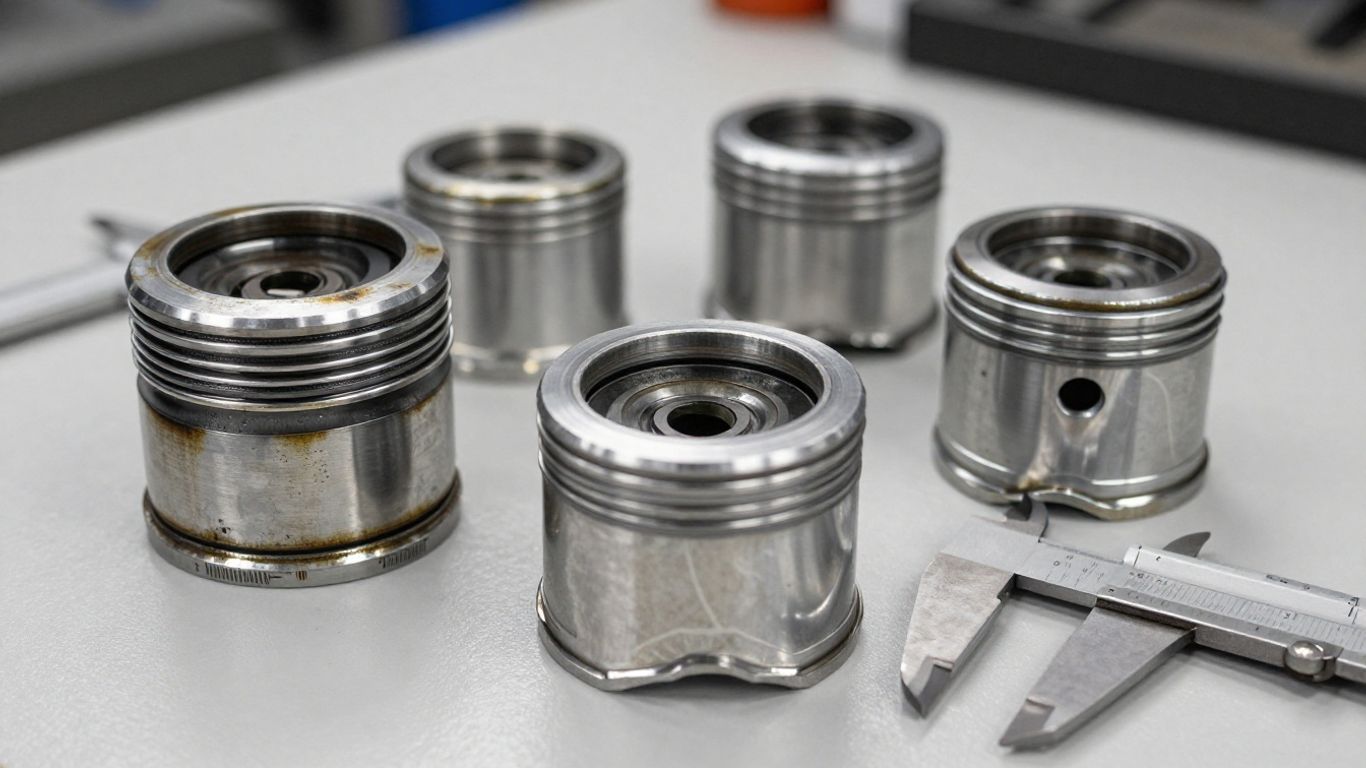
Used pistons deserve a close inspection because some damage is hidden by dirt, paint, or quick cleaning. Look at each piston individually rather than accepting a photograph of one representative piece. The goal is not to find parts that look attractive, but parts that remain dimensionally sound and free from fatigue damage.
Inspecting piston crowns for damage
The crown should be checked for deep dents, melted areas, unusual pitting, and marks that suggest contact with a valve. Light carbon staining is expected on many used parts, while sharp impact damage is not. Ask for close, well-lit photographs of every crown, especially if the seller has removed the original carbon deposits.
Checking skirts for scoring and wear
The skirt guides the piston through the bore, so vertical scoring, smeared aluminum, and unusually polished patches deserve attention. Compare the thrust and non-thrust sides, since wear may not be even. Visible skirt damage matters because a piston can have a clean crown while still being unsuitable for reuse.
Looking for cracks, distortion, and overheating
Inspect around the pin bosses, ring lands, and underside for cracks or repairs. A gray or discolored area may indicate overheating, though color alone cannot establish serviceability. If a piston has collapsed skirt geometry, chipped lands, or a damaged pin bore, it should be rejected rather than treated as a bargain.
Evaluating cleaned versus reconditioned pistons
Cleaning removes deposits; it does not restore worn dimensions. Reconditioning should be supported by details such as dimensional inspection, pin-bore checks, or machining records. Before buying, ask exactly what work was performed and whether the seller is offering a measured component or simply a washed and photographed used part.
Evaluating used piston rings before purchase
Piston rings operate in a demanding environment and can lose their shape even when they appear intact. A ring set should be assessed as a matched component, not just as a collection of metal circles. Check whether the rings are new, previously run, cleaned, or mixed from different engines.
Measuring ring thickness and diameter
Measure ring thickness with suitable tools and compare it with the engine specification. Diameter by itself is not enough because a ring can fit the bore while having the wrong thickness for the groove. A general piston ring guide can explain sealing, oil control, and heat transfer, but your engine manual remains the authority for exact dimensions.
Checking for corrosion and sticking
Surface rust, flaking coatings, and corrosion around the ring edges can prevent proper sealing. Used rings may also stick in their grooves after exposure to carbon or moisture. If the seller cannot confirm storage conditions or provide close images of the ring faces, price the set as a high-risk purchase or choose new rings instead.
Inspecting ring grooves and contact surfaces
The piston groove must be clean, square, and free from excessive widening. Place the ring into its groove and check for abnormal side play, but do not force it over the piston with improvised tools. Signs of stuck piston rings include poor compression and oil-related symptoms, which is why groove condition deserves the same attention as the ring itself.
Understanding when new rings are the safer choice
New rings are usually the safer choice when used rings have unknown mileage, visible wear, or uncertain storage history. They are also sensible when the piston is reusable but the old rings have lost tension. A new set cannot correct a worn bore or oversized groove, so it must still be paired with accurate measurements.
Verifying measurements and engine fit
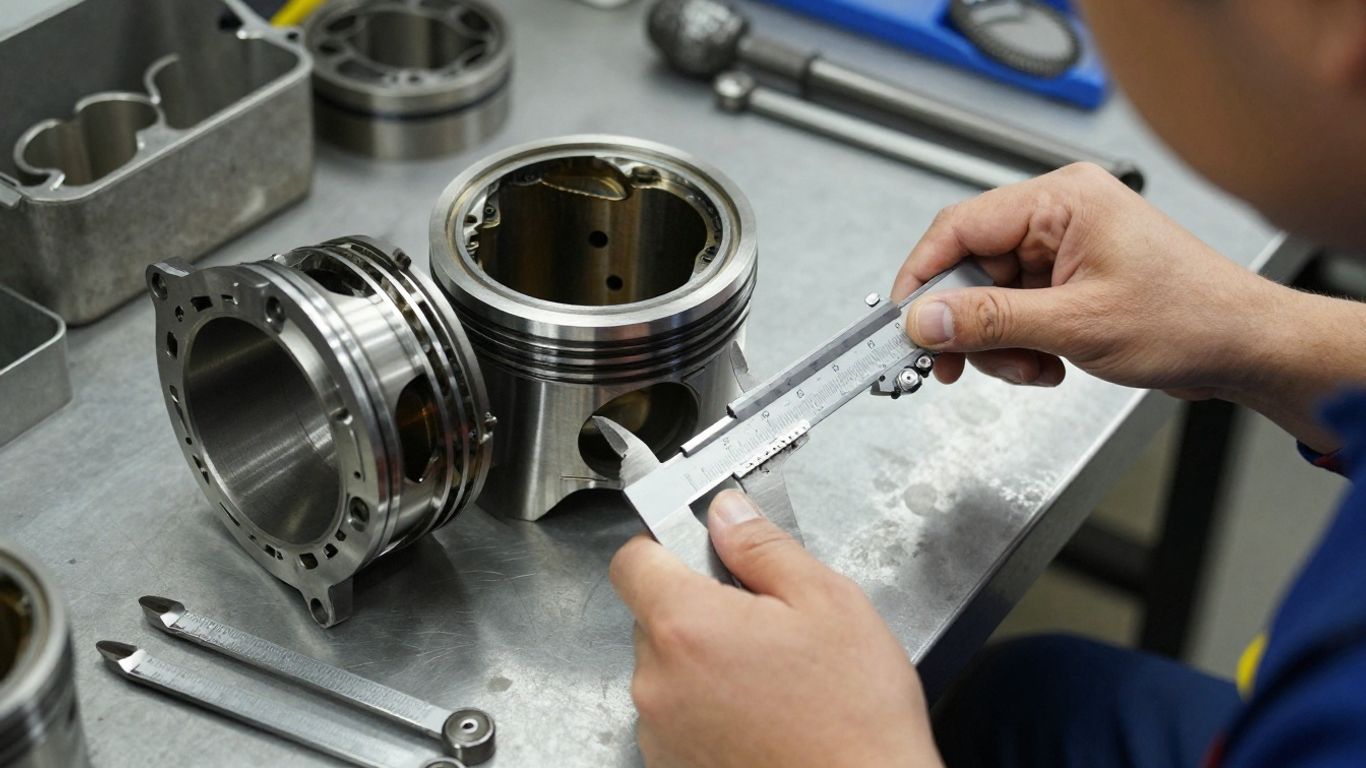
Measurements turn a hopeful purchase into an informed decision. Even a correctly identified part may not suit a cylinder that has been worn, bored, or honed beyond its original specification. Take readings from the engine and the replacement parts, then compare them with the service-manual limits rather than relying on visual judgment.
Measuring cylinder bore and piston clearance
Measure the bore at several heights and in more than one direction to identify taper and out-of-round wear. Measure the piston at the manufacturer’s specified gauge point, not wherever the skirt looks widest. The difference between those readings gives piston-to-wall clearance, which must remain within the specified range.
Checking ring end gap inside the cylinder
Insert each ring squarely into its intended cylinder and use a piston to position it evenly below the deck. Then measure the opening with a feeler gauge. An end gap that is too tight can close as the engine heats, while an excessive gap can weaken sealing and increase oil movement.
Confirming compression and oil ring positions
Separate compression rings from oil-control components before installation. Check markings, bevels, dots, or manufacturer instructions for the correct upward direction, and keep the ring gaps staggered as specified. Do not guess the oil-ring expander arrangement; an incorrectly overlapped expander can cause immediate trouble.
Using service-manual tolerances to make a decision
A service manual should provide limits for bore wear, piston clearance, ring gaps, and groove dimensions. Record the readings in a simple worksheet so that a borderline result is not forgotten during assembly. The following checks make a useful purchase screen:
- Confirm the engine code and piston dimensions.
- Compare bore wear with the permitted service limit.
- Measure every ring rather than one sample.
- Reject components with cracks or unexplained distortion.
These checks do not replace machining expertise, but they make it easier to identify parts that should be returned before the engine is assembled.
Finding reliable used Chery pistons and rings
The seller’s process often reveals more than the listing headline. A reliable source should be able to explain where the parts came from, how they were identified, and what condition they are in. Keep the conversation practical: ask for measurements, clear photographs, and written confirmation of the return terms.
Comparing salvage yards, recyclers, and online sellers
Salvage yards may provide an engine history or allow a direct inspection, while online sellers can offer broader inventory but require stronger verification. Recyclers that catalog parts by engine code are generally easier to work with than sellers using only generic vehicle categories. For comparison, even unrelated buying pages such as Online DBS Checks, Kaboom Beverage Menu, Moroccan hair oil guide, Healthy Self Weight Loss, and Royal LePage Brookside Realty demonstrate why a clear description and defined scope matter; here, the relevant scope is mechanical fit.
Reviewing photos, descriptions, and part numbers
Look for photographs of crowns, skirts, grooves, pins, and ring faces rather than stock images. The description should state the part number, engine application, quantity, and known defects. If the listing omits measurements, request them in writing so there is a record of what was represented.
Asking about mileage and engine history
Mileage is only one clue. Ask whether the engine was running when removed, why it was dismantled, and whether it suffered overheating, oil starvation, or a broken timing component. A piston from an engine with a known mechanical failure may need more scrutiny even if its outside surfaces look acceptable.
Checking return policies and shipping protection
Confirm whether returns are allowed after inspection and who pays shipping when the part is misidentified. Photograph the package before opening it and document any damage immediately. Good packaging cannot fix a wrong part, but shipping protection can prevent a reasonable purchase from becoming an avoidable loss.
Installing and maintaining replacement components
Correct installation protects the money already spent on parts and machining. Cleanliness, orientation, and measurement should guide the assembly, not speed. If a piston, ring, or bore does not meet the specification, stop and resolve the issue before closing the engine.
Preparing the pistons, rings, and cylinders
Wash the pistons and cylinders with the recommended solvent and a clean, lint-free process, then dry them fully. Remove carbon from the grooves without widening or scratching them. Coat the relevant surfaces with clean assembly lubricant as directed, and keep each piston and ring set associated with its intended cylinder when the design requires it.
Installing rings in the correct orientation
Use a ring expander rather than twisting rings over the piston by hand. Confirm the top mark and groove position, then check that each ring moves freely in its groove. Before inserting the piston, set the end gaps according to the service instructions and avoid placing them all in one line.
Replacing related gaskets and bearings
A rebuild is a poor time to reuse crushed gaskets, questionable seals, or bearings with visible wear. Inspect the connecting rod, wrist pin, clips, and cylinder surface alongside the piston. Replacing related wear items can prevent a newly installed ring set from being blamed for a problem originating elsewhere.
Breaking in the rebuilt engine properly
Follow the engine builder’s break-in procedure, use the specified oil, and watch for leaks, overheating, smoke, and abnormal noise. Avoid prolonged idling if the procedure calls for varied engine speed and load. Change the oil and filter according to the break-in guidance, then investigate unusual oil consumption rather than hoping it will disappear.
Conclusion
Used Chery pistons and rings are worth considering when their identity, condition, and measurements can be verified. A careful buyer checks the engine code, rejects damaged components, confirms clearances, and chooses a seller who stands behind the listing. That disciplined process costs less than assembling an engine around parts that only looked compatible.
Frequently Asked Questions
Can used pistons be reused safely?
They can be reused when inspection and measurements show that the crown, skirt, ring lands, pin bore, and overall dimensions remain within the applicable limits. A clean appearance alone is not enough.
Should used piston rings be replaced with new ones?
Usually, new rings are the safer choice when the old rings have unknown mileage, corrosion, sticking, or measurable wear. New rings still require a suitable piston groove and cylinder bore.
How do I identify the correct piston for my engine?
Use the exact model, engine code, production year, piston part number, and measured dimensions. Confirm the result against a service manual or a qualified machine shop.
What damage makes a piston unsuitable?
Cracks, broken ring lands, severe skirt scoring, distorted geometry, damaged pin bores, and signs of serious overheating are strong reasons to reject a piston.
How is piston-to-wall clearance checked?
Measure the cylinder bore at multiple points and measure the piston at the specified gauge location. Subtract the piston measurement from the corresponding bore measurement and compare the result with the service limit.
What does excessive ring end gap cause?
Excessive end gap can reduce sealing and contribute to greater oil movement or blow-by. The correct limit depends on the engine and ring specification.
What should I ask a used-parts seller?
Ask for the engine code, part number, mileage, removal reason, operating history, measurements, photographs of every component, and the written return policy.